
A cleanroom is a controlled space with filtered air, so that dust does not land on a hard drive’s platters when it is opened. Opening a drive in ordinary air can destroy data that could have been saved.
Key takeaways
- The gap between a head and a platter is smaller than a speck of smoke.
- Dust on a platter can scratch it when the drive spins.
- Physical repairs such as head replacement should be done in a clean, controlled space.
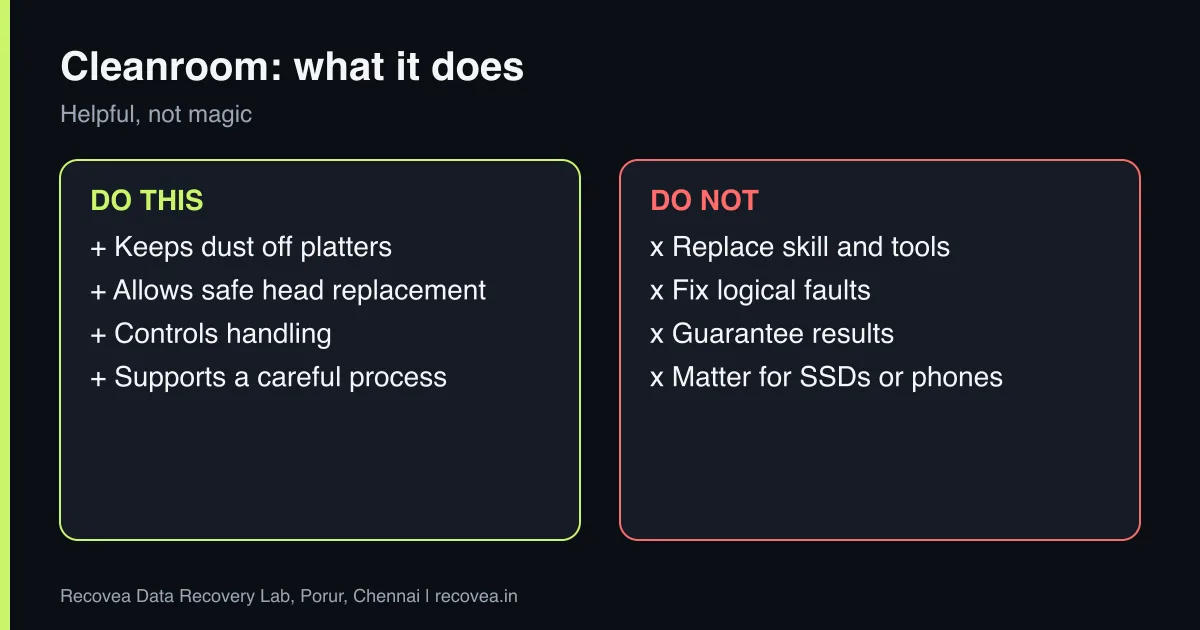
- A cleanroom does not make a poor engineer good. Tools, skill and process matter too.
- Ask any lab how it handles drives, and see photos of its setup.
In this guide
- Why dust matters
- What a cleanroom or controlled environment provides
- What it is used for
- Cleanroom is not the whole story
- Questions to ask a lab
- What to note before you contact a lab
- How to prevent it next time
- Frequently asked questions
Written by the Recovea lab team, Porur, Chennai. Last reviewed 16 November 2026.
Why dust matters
Inside a hard drive, the read/write heads fly a few nanometres above the platters. A particle of dust, a hair or a fingerprint is far larger than that gap. If one lands on a platter and the drive spins, it can cause scratches and head crashes. Drives are sealed at the factory in a clean environment for this reason.
Why a cleanroom matters
What can go wrong when a drive is opened without one
stop careful safe
What a cleanroom protects against.
What a cleanroom or controlled environment provides
- Filtered air with very few particles.
- Controlled access, clean clothing and gloves.
- A clean, anti-static workbench.
- A procedure for opening, handling and sealing drives.
What it is used for
- Head replacement.
- Platter inspection.
- Motor and platter transfer in severe cases.
- Any task where the platters are exposed.
Logical faults and firmware work do not need the drive opened and are done outside it.
Ask our experts: free diagnosis. Send us a message on WhatsApp and we reply within 30 minutes during working hours (Monday to Saturday, 10:30 to 20:00). Recovery starts from ₹990, physical and complex cases are quoted individually after diagnosis, and if we cannot recover your data, you do not pay.
Chat on WhatsApp | Call +91 79046 79817 | Ask D, free diagnosis
Cleanroom is not the whole story
A cleanroom helps, but the results depend on the engineer, the tools (such as PC-3000), a stock of matching donor parts, and a careful imaging process. A good lab explains its process and does not promise perfect results.
Questions to ask a lab
- Do you have a cleanroom or controlled environment, and may I see photos?
- What tools do you use?
- Do you open drives for diagnosis, and when?
- What happens to my data afterwards?
Recovea has a cleanroom and a controlled environment in Porur. Read our checklist for choosing a lab.
A cleanroom routine
What controlled work looks like
The routine inside a cleanroom.
What to note before you contact a lab
A few details help the engineer diagnose faster and quote more accurately. Write down the drive brand, model and capacity (printed on the label), how old it is, what happened just before the problem began (a drop, a power cut, a Windows update, a noise), and which files matter most. If it is an external drive, note whether the enclosure has a separate power adapter. Do not worry if you do not know all of this: the free diagnosis fills in the rest. Keep the drive in an anti-static bag or a padded box until it reaches us.
How to prevent it next time
Hard drives are mechanical, and every one will fail eventually. The only real protection is a second copy of what matters. Follow the 3-2-1 idea: three copies, on two different kinds of storage, with one stored somewhere else (a cloud service or a drive at another location). Do not move a laptop or external drive while it is running, use the right power supply for external drives, and replace any drive that starts to make new noises, freezes on certain files or shows errors. Test your backup sometimes by restoring one file.
Ask our experts: free diagnosis. Send us a message on WhatsApp and we reply within 30 minutes during working hours (Monday to Saturday, 10:30 to 20:00). Recovery starts from ₹990, physical and complex cases are quoted individually after diagnosis, and if we cannot recover your data, you do not pay.
Chat on WhatsApp | Call +91 79046 79817 | Ask D, free diagnosis
Frequently asked questions
Is a cleanroom necessary?
For opening a hard drive, yes, in a clean controlled space. Not for logical or firmware work.
Can I open a drive at home?
No. Dust can ruin the platters.
What does a cleanroom cost?
It is part of the lab’s running cost; we do not charge extra for it.
Can I see your cleanroom?
Please call first to arrange a visit.
How much does recovery cost?
Diagnosis is free; recovery starts from ₹990.
Related guides and services
- Hard drive clicking noise: what to do first
- How long does data recovery take?
- How to choose a data recovery service in Chennai
- Does the freezer trick work? Why it is a myth
- Hard disk data recovery in Chennai
- About Recovea
Recovea is a data recovery lab at 2nd Floor, Plot No-4, Thiraviyam Nagar 1st Street, Sai Nagar, Porur, Chennai 600116. We accept drives by pickup or courier from anywhere in India.