

An SSD that disappears, shows 0 GB or appears with a strange name usually has a controller or firmware fault, not empty memory. The data is normally still in the flash chips, but the controller cannot present it. Do not keep power cycling it.
Key takeaways
- The controller is the SSD’s brain. If it fails, the drive vanishes or shows 0 GB, but the chips often still hold your data.
- Do not format, initialise or run tools. They cannot fix a controller fault.
- Firmware repair or chip-level reading can recover data in many cases, depending on the model and encryption.
- Encrypted SSDs may need the original controller or the keys.
- Diagnosis is free at Recovea, and you pay only if data is recovered.
In this guide
- What the controller does
- Typical symptoms
- Common causes
- What to do and not do
- How a lab recovers data
- Time and cost
- What to note before you contact a lab
- How to prevent it next time
- Frequently asked questions
Written by the Recovea lab team, Porur, Chennai. Last reviewed 16 November 2026.
What the controller does
An SSD has memory chips and a controller. The controller keeps a map (the translation layer) linking the addresses your computer uses to the physical locations in the chips, spreads writes evenly and handles encryption. If the controller or its map is damaged, the computer sees nothing, or sees a drive of 0 GB or a few MB with a generic name such as the controller maker.
Typical symptoms
- Not detected in BIOS, or detected only sometimes.
- Shown as 0 GB, 8 MB or a generic name.
- Disappears after a few minutes of use.
- Becomes read-only, or very slow.
- Laptop will not boot and the SSD is missing from the boot menu.
Common causes
- Firmware corruption after a power cut or a faulty update.
- Controller failure from heat or a power surge.
- Damaged translation map.
- Worn-out flash memory reaching the end of its life.
- Faulty connector or board.
SSD not detected: what it means
What you see, likely cause and the safe next step
stop careful safe
What a missing or 0 GB SSD usually means.
What to do and not do
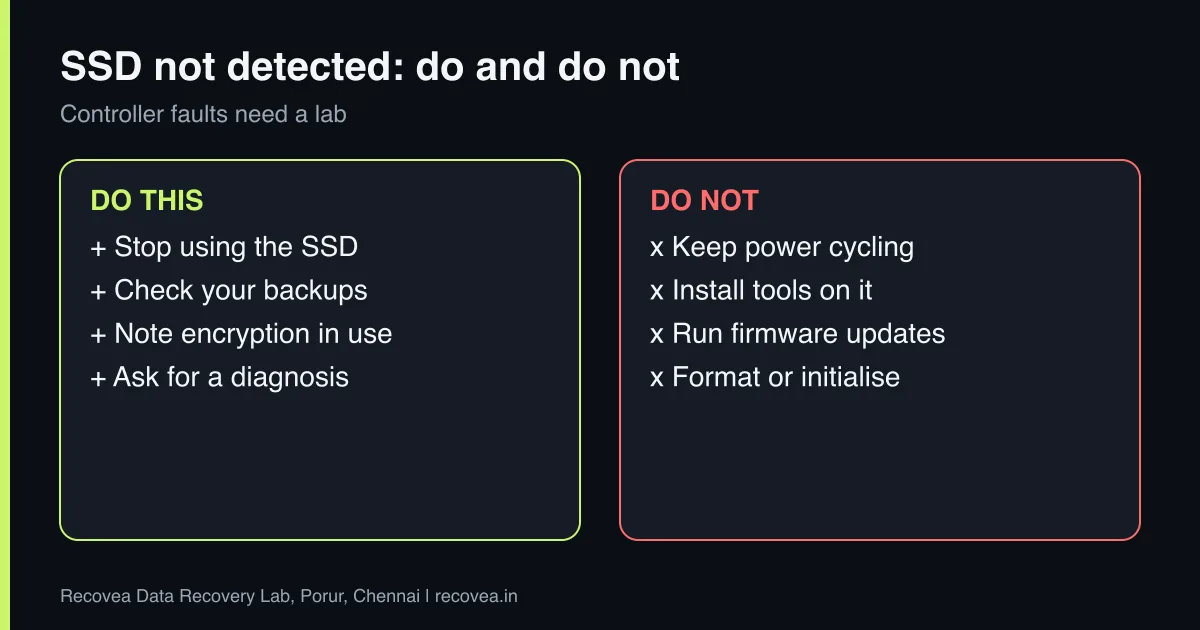
- Stop using the SSD, and remove it from the computer if you can.
- Do not keep power cycling it. Some failing controllers lose more data each time.
- Do not install recovery tools on it or run firmware updates.
- Check your backups.
- Ask a lab for a diagnosis.
Ask our experts: free diagnosis. Send us a message on WhatsApp and we reply within 30 minutes during working hours (Monday to Saturday, 10:30 to 20:00). Recovery starts from ₹990, physical and complex cases are quoted individually after diagnosis, and if we cannot recover your data, you do not pay.
Chat on WhatsApp | Call +91 79046 79817 | Ask D, free diagnosis
How a lab recovers data
The engineer first tries to bring the controller back with specialised tools. If the firmware is damaged, it can sometimes be repaired and the drive read normally. If the controller is dead, the memory chips can be read directly (chip-level recovery), and the translation map is rebuilt in software to put the data back in order. This depends on the model and on encryption: if the data is encrypted with keys held in the controller, it may not be possible. We tell you honestly after the diagnosis, and sign an NDA for chip-level work where needed.
How SSD recovery works
When the controller will not respond
How SSD data is recovered in a lab.
Time and cost
Diagnosis is free. Recovery starts from ₹990; chip-level and complex SSD cases are quoted individually. You pay only if your data is recovered.
What to note before you contact a lab
Tell the engineer the brand, model and capacity, what device it was used in (camera, phone, laptop, drone), and what happened just before the problem: a removal during writing, a format prompt, a power cut. Note if the device is encrypted. Stop using the storage at once, because every write can overwrite what you want back. Keep memory cards and pen drives in a small anti-static bag or case. A free diagnosis tells you whether the problem is logical or a chip or controller fault.
How to prevent it next time
Flash storage fails without warning. Copy photos and files off cards and pen drives as soon as you can, keep at least two copies, and do not delete from the card in the camera until both copies are checked. Use the safe-eject option, never remove a card while the light is blinking, and format cards in the device that will use them rather than on a computer. For SSDs, keep system and personal files backed up to a second drive or the cloud, and keep your encryption recovery keys safe.
Ask our experts: free diagnosis. Send us a message on WhatsApp and we reply within 30 minutes during working hours (Monday to Saturday, 10:30 to 20:00). Recovery starts from ₹990, physical and complex cases are quoted individually after diagnosis, and if we cannot recover your data, you do not pay.
Chat on WhatsApp | Call +91 79046 79817 | Ask D, free diagnosis
Frequently asked questions
Why does my SSD show 0 GB?
The controller cannot read its map. The data is often still in the chips.
Can an SSD that is not detected be recovered?
Often, through firmware repair or chip-level reading, depending on the model.
Is it the same as deleted files?
No. Deleted files can be erased by TRIM. A controller fault usually leaves the data in the chips.
Does encryption matter?
Yes. If the keys are tied to the controller or the computer, recovery may not be possible.
How much does it cost?
Diagnosis is free; recovery starts from ₹990, and chip-level work is quoted after diagnosis.
Related guides and services
- Deleted files from an SSD: TRIM explained
- External SSD not detected: causes and recovery options
- Formatted SSD or pen drive: recovery chances
- How much does data recovery cost in India?
- SSD and NVMe data recovery
- Pen drive and memory card recovery
Recovea is a data recovery lab at 2nd Floor, Plot No-4, Thiraviyam Nagar 1st Street, Sai Nagar, Porur, Chennai 600116. We accept drives by pickup or courier from anywhere in India.