

If you formatted a pen drive or SSD by mistake, stop using it now. A quick format only clears the index, so files are often still there on a pen drive. On an SSD, TRIM can erase them, so speed matters.
Key takeaways
- A quick format removes the file index, not the data. A full format may overwrite.
- Pen drives and cards often keep their data after a quick format.
- SSDs may erase data after a format because of TRIM, so stop using the drive at once.
- Do not save anything new to the drive. Do not install recovery tools on it.
- File names and folders may or may not come back, depending on what was overwritten.
In this guide
- Quick format and full format
- Chances by device
- Do this now
- What not to do
- How recovery works
- Cost and time
- What to note before you contact a lab
- How to prevent it next time
- Frequently asked questions
Written by the Recovea lab team, Porur, Chennai. Last reviewed 16 November 2026.
Quick format and full format
A quick format creates a fresh, empty file system index and leaves the old data where it was. A full format also scans the drive and, depending on the system, may write zeros over it. On a pen drive or card, the difference decides whether recovery is likely. On an SSD, the system may also send TRIM commands after a format, telling the drive that all blocks are free.
Chances by device
- Pen drive or SD card, quick format: good chance, if nothing new was written.
- Pen drive or card, full format: lower, depends on the system.
- SSD, quick format: uncertain because of TRIM. See TRIM explained.
- Any device, reformatted and refilled: low, as new data overwrites the old.
Formatted drive: your chances
It depends on what you did, and what happened next
stop careful safe
Your chances after each type of format.
Do this now
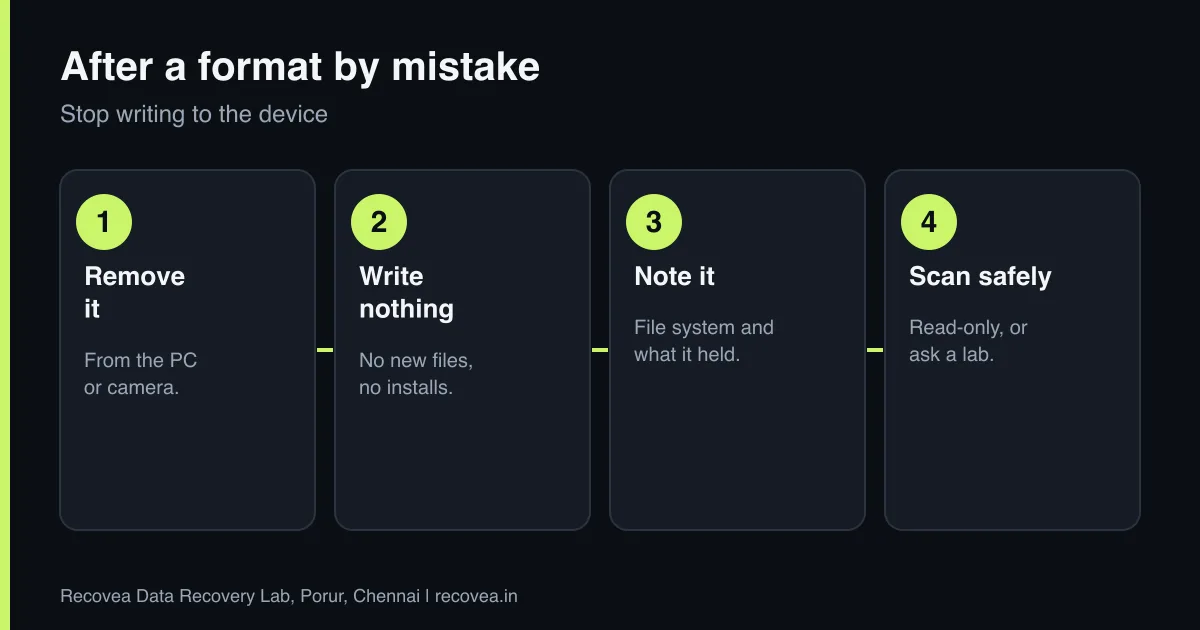
- Stop using the device and remove it from the computer or camera.
- Do not copy new files onto it.
- Do not install recovery software onto the same device.
- Note which file system it had before (exFAT, NTFS, FAT32) and what it held.
- Get advice before you scan, because a scan can be done safely only on a healthy device.
After a format: quick decision path
Follow the arrows and stop at the first YES
Did you save new files after the format?
If no, go to the next question
Overwritten parts are gone. Stop now.
Is it an SSD with TRIM turned on?
If no, go to the next question
Switch it off. Chances fall with time.
Was it a quick format of a card or hard drive?
If no, go to the next question
Good chance. Stop and scan or ask a lab.
Full format: tell the lab. Recovery is limited.
What to do right after formatting.
What not to do
- Do not format it again to “fix” it.
- Do not keep inserting it into different devices, which may write hidden files.
- Do not run tools that “repair” the drive.
Ask our experts: free diagnosis. Send us a message on WhatsApp and we reply within 30 minutes during working hours (Monday to Saturday, 10:30 to 20:00). Recovery starts from ₹990, physical and complex cases are quoted individually after diagnosis, and if we cannot recover your data, you do not pay.
Chat on WhatsApp | Call +91 79046 79817 | Ask D, free diagnosis
How recovery works
The engineer makes a read-only copy of the device, then scans the copy for the old file system and for file signatures (photos, documents, videos). If old structures are intact, folders and names come back. If not, files are found by type and may need to be renamed. For a failing device, the work starts with hardware checks, and chip-level reading is used where needed.
Cost and time
Diagnosis is free. Logical recoveries commonly take 24 to 72 hours. Recovery starts from ₹990, and complex cases are quoted after diagnosis. You pay only if data is recovered.
What to note before you contact a lab
Tell the engineer the brand, model and capacity, what device it was used in (camera, phone, laptop, drone), and what happened just before the problem: a removal during writing, a format prompt, a power cut. Note if the device is encrypted. Stop using the storage at once, because every write can overwrite what you want back. Keep memory cards and pen drives in a small anti-static bag or case. A free diagnosis tells you whether the problem is logical or a chip or controller fault.
How to prevent it next time
Flash storage fails without warning. Copy photos and files off cards and pen drives as soon as you can, keep at least two copies, and do not delete from the card in the camera until both copies are checked. Use the safe-eject option, never remove a card while the light is blinking, and format cards in the device that will use them rather than on a computer. For SSDs, keep system and personal files backed up to a second drive or the cloud, and keep your encryption recovery keys safe.
Ask our experts: free diagnosis. Send us a message on WhatsApp and we reply within 30 minutes during working hours (Monday to Saturday, 10:30 to 20:00). Recovery starts from ₹990, physical and complex cases are quoted individually after diagnosis, and if we cannot recover your data, you do not pay.
Chat on WhatsApp | Call +91 79046 79817 | Ask D, free diagnosis
Frequently asked questions
Can I recover a formatted pen drive?
Often, after a quick format, if nothing new was written.
Can I recover a formatted SSD?
Sometimes. It depends on whether TRIM erased the blocks. Stop using it at once.
Will file names come back?
Often if old structures remain. Otherwise files are found by type.
Does a full format erase everything?
Not always, but it may. It depends on the system and the device.
How much does it cost?
Diagnosis is free; recovery starts from ₹990.
Related guides and services
- Pen drive asks to format or shows 0 bytes
- Deleted files from an SSD: TRIM explained
- Memory card corrupted or camera error
- Data recovery software or a professional lab
- Pen drive and memory card recovery
- SSD and NVMe data recovery
Recovea is a data recovery lab at 2nd Floor, Plot No-4, Thiraviyam Nagar 1st Street, Sai Nagar, Porur, Chennai 600116. We accept drives by pickup or courier from anywhere in India.